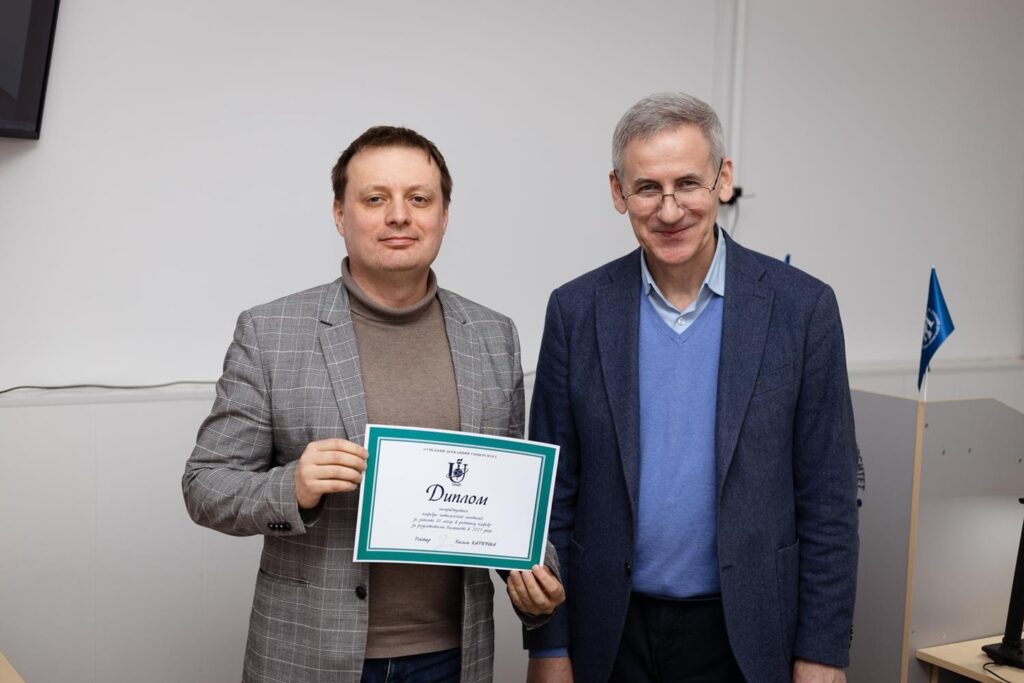
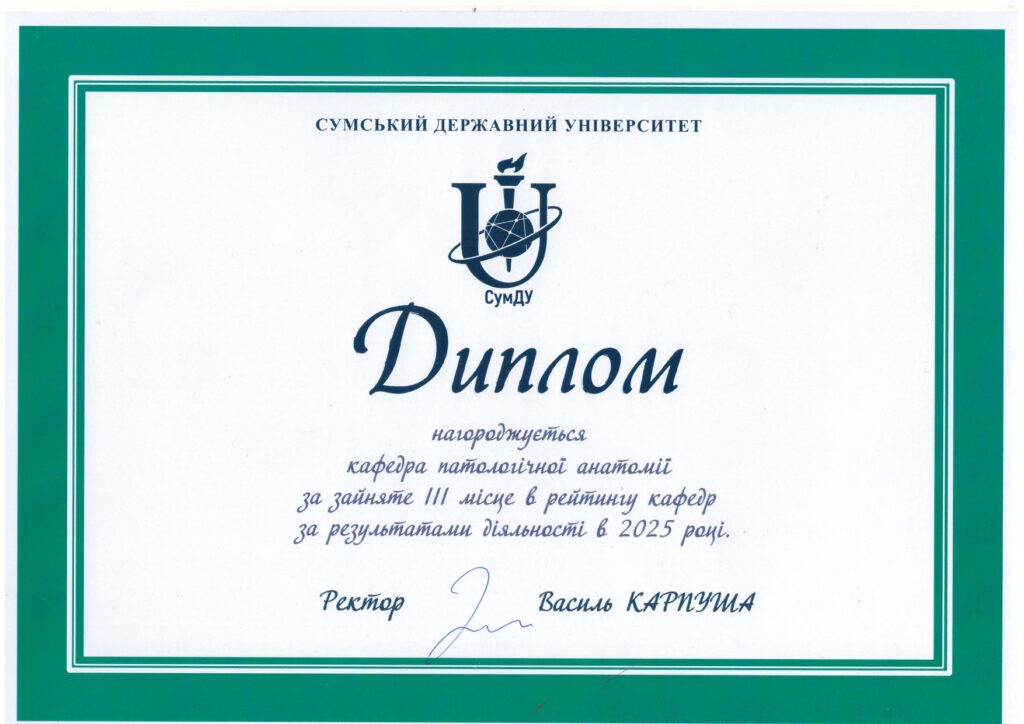
Last year, we took first place in the ranking of Sumy State University’s (SumDU) structural units – a crowning achievement of our 15-year participation and the first (and only) victory for a department within the Medical Institute. While it seemed like the peak at the time, the results of the 2025 SumDU University-wide rankings prove otherwise: the Department of Pathology didn’t just “sprint” onto the pedestal; it has confidently moved in.
This year’s result – 3rd place in the university-wide ranking – might seem like a step back to some, but for our team, this is true “bronze.” It confirms that high performance is not a coincidence, but the result of a well-oiled machine. We are beginning a new cycle where the main criterion is not just leadership, but the stability of results during incredibly challenging times.
Our strengths in 2025 remained unchanged but grew qualitatively deeper. The combination of experience and energy from our lecturers and scientists allows us to maintain a high bar of professional excellence (as confirmed by individual faculty rankings). Our Youth Scientific Society of Pathology is not a formality, but a vibrant platform for training the future elite. Regular meetings, clinical case studies, and conference preparations all contribute to our collective success. The Scientific Center for Pathomorphological Research continues to demonstrate sustainable development, ensuring high indicators in economic and innovative activities. Our active presence in the global scientific community is reflected in publications in top-tier journals (which we review for our students), as well as travel grants and international internships. We also actively share our journey online – your engagement with our news is also a part of our ranking!
We soberly assess the indicators that require improvement. For us, for example, “student body formation” is a complex challenge as a non-graduating department, but we are seeking solutions by attracting interns, PhD students, and developing postgraduate education programs. Another challenging metric is the “integral assessment of multidisciplinary activity,” which requires even greater synchronization across all departmental functions.
The key to the department’s success—built by Prof. Anatoliy Romanyuk—remains academic freedom and mutual support. Even in times of wartime hardship and staff optimization, we prove that quality does not depend on quantity.
The 2025 “Bronze” marks the completion of one stage and the start of a new distance. Ahead of us is the May conference, Sumy Pathology Horizons, and new challenges that we are ready to embrace.
My thanks to the staff and students for every point invested in this success!
Head of the Department of Pathology — Roman Moskalenko